
Key takeaways
- Website prices vary hugely because scope varies hugely: number of pages, design, features, content, languages and integrations.
- Your options range from DIY website builders (low cash cost, high time cost) to templates set up by a pro and fully custom designs.
- Budget for running costs too: domain, hosting, security updates, backups, plugins or app subscriptions and occasional changes.
- Compare quotes on the same scope, and check who owns the design, code, domain and content.
- The cheapest website is the one that wins customers — fast, clear, mobile-first and easy to book from.
“How much is a website?” is a bit like “how much is a car?”. A tidy five-page site for a café and a multilingual online shop with bookings and integrations are very different projects. This guide explains what you’re paying for so you can budget sensibly and compare quotes with confidence.
What affects the price?
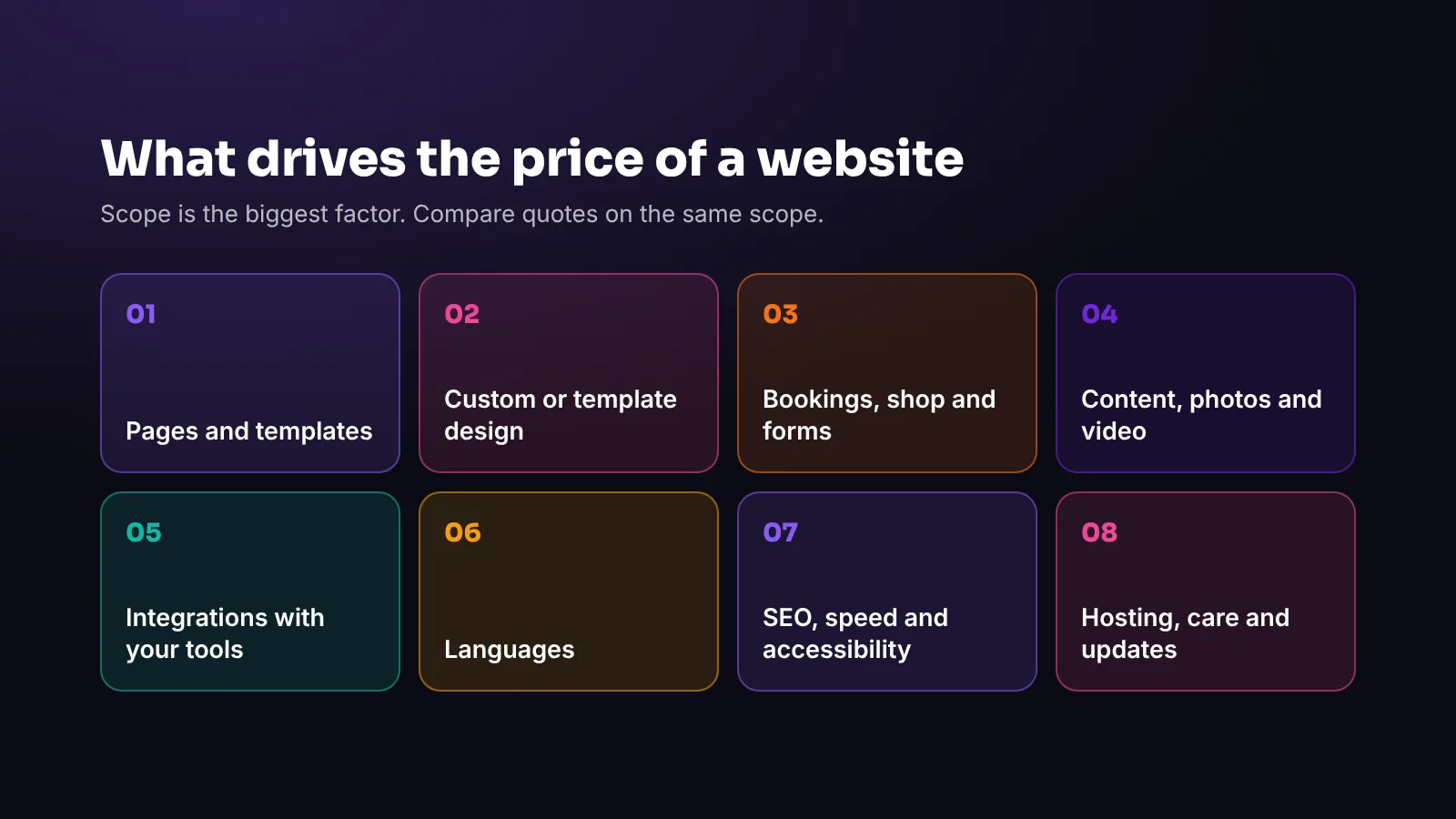
- Number of pages and templates — a homepage, services, about and contact is very different from 60 product and location pages.
- Design — adapting a template, or a custom design built around your brand.
- Features — bookings, online ordering, a shop, member areas, forms, maps, chat, multilingual content.
- Content — who writes the text, takes the photos and produces video.
- Integrations — booking systems, payment providers, CRM, email marketing, point of sale.
- Search and performance work — structured data, page speed, accessibility and analytics with cookie consent.
- Languages — each language adds translation, checking and maintenance.
Your options
1. DIY website builder
Hosted builders let you assemble a site yourself from templates for a monthly subscription.
- Good for: very small budgets, simple sites, people who enjoy doing it themselves.
- Watch out for: the time it takes, generic design, limited performance and SEO control, and the cost of add-on apps over time.
2. A template set up by a professional
A designer or agency adapts a quality theme to your brand, adds your content and sets up the essentials.
- Good for: small businesses that want a professional result quickly at a moderate cost.
- Watch out for: heavy themes that load slowly, and what happens when you need a feature the theme doesn’t support.
3. Custom design and build
A site designed around your brand, customers and goals, built for speed and search.
- Good for: businesses where the website drives bookings or sales, multilingual sites, and anyone who needs integrations or custom features.
- Watch out for: unclear scope. A good provider gives a written scope, a fixed quote and clear stages.
Typical price ranges
Prices differ by country, provider and scope, so treat these as rough market ranges rather than quotes:
- DIY builder: a monthly subscription, plus your own time.
- Small professionally built site (5–10 pages): commonly from around €1,500 to €5,000 / £1,300 to £4,500.
- Larger or custom sites with bookings, multiple languages or integrations: commonly €5,000 to €15,000+ / £4,500 to £13,000+.
- Online shops and web applications: depend heavily on the number of products, features and integrations.
Viraluna Studio prices every website project with a fixed written quote based on your scope, usually paid in stages. Ask for a quote.
Running costs people forget
- Domain name — renewed every year.
- Hosting — from simple shared hosting to managed hosting with backups and monitoring.
- Security and updates — software, plugins and themes need regular updates.
- Backups and monitoring — so a problem is a short fix, not a disaster.
- Subscriptions — booking systems, shop apps, email marketing, premium plugins.
- Changes — new menus, prices, offers, pages and photos.
A care plan bundles these into one predictable monthly fee.
How to compare website quotes
Ask every provider:
- Exactly which pages and features are included?
- Is the design custom or based on a template?
- Who writes the content and supplies photos?
- Is it built mobile-first, and will it meet Google’s Core Web Vitals “good” thresholds?
- Are SEO basics, structured data, accessibility and cookie consent included?
- Who owns the domain, design, code and content when it’s finished?
- What are the running costs, and what does a care plan include?
- How many rounds of changes are included, and how are extras priced?
Then compare like with like. A cheaper quote that excludes content, SEO or bookings may cost more in the end.
What’s worth paying for
- Speed and mobile design — most visitors arrive on a phone; see our website checklist.
- A clear path to book or buy — every extra step loses people.
- Search foundations — so the site actually gets found (see our local SEO guide).
- Real photos and good copy — they build more trust than any effect or animation.
- Ownership and documentation — so you’re never locked in.
Frequently asked questions
How much does a small business website cost?
It depends on scope. A DIY builder costs a monthly subscription plus your time; a small professionally built site commonly costs from around €1,500 to €5,000 (about £1,300 to £4,500); larger custom sites with bookings, languages or integrations cost more.
What are the ongoing costs of a website?
Domain renewal, hosting, security updates, backups, any subscriptions for bookings or shop features, and changes over time. Many businesses choose a monthly care plan.
Is a website builder good enough for a small business?
It can be for a simple site, if you have the time. Professional builds tend to be faster, better designed and better optimised for search and bookings.
How long does it take to build a website?
Most small business websites take three to six weeks from kick-off to launch, depending on pages, features and how quickly content is ready.
Who should own my website?
You should. Make sure you own your domain, content and, once paid, the design and code — and that you have the logins.
The bottom line
Decide what your website must do — get found, explain, convince and convert — then pay for the scope that delivers it. Compare quotes on the same questions, budget for running costs and make sure you own what you pay for.
Viraluna Studio designs and builds fast, accessible websites and online shops for businesses across the UK and Europe, with fixed quotes and progress you approve in your portal. Explore our website service or read how to start an online shop.