Key takeaways
- AI assistants recommend businesses they can describe accurately and confidently from trustworthy sources.
- Keep your name, address, phone and hours identical everywhere, starting with your Google Business Profile.
- Make your website answer real questions in plain text, and add structured data (schema.org).
- Earn genuine reviews and mentions in local guides, news and directories.
- Check robots.txt allows the crawlers that power AI search, such as OAI-SearchBot.
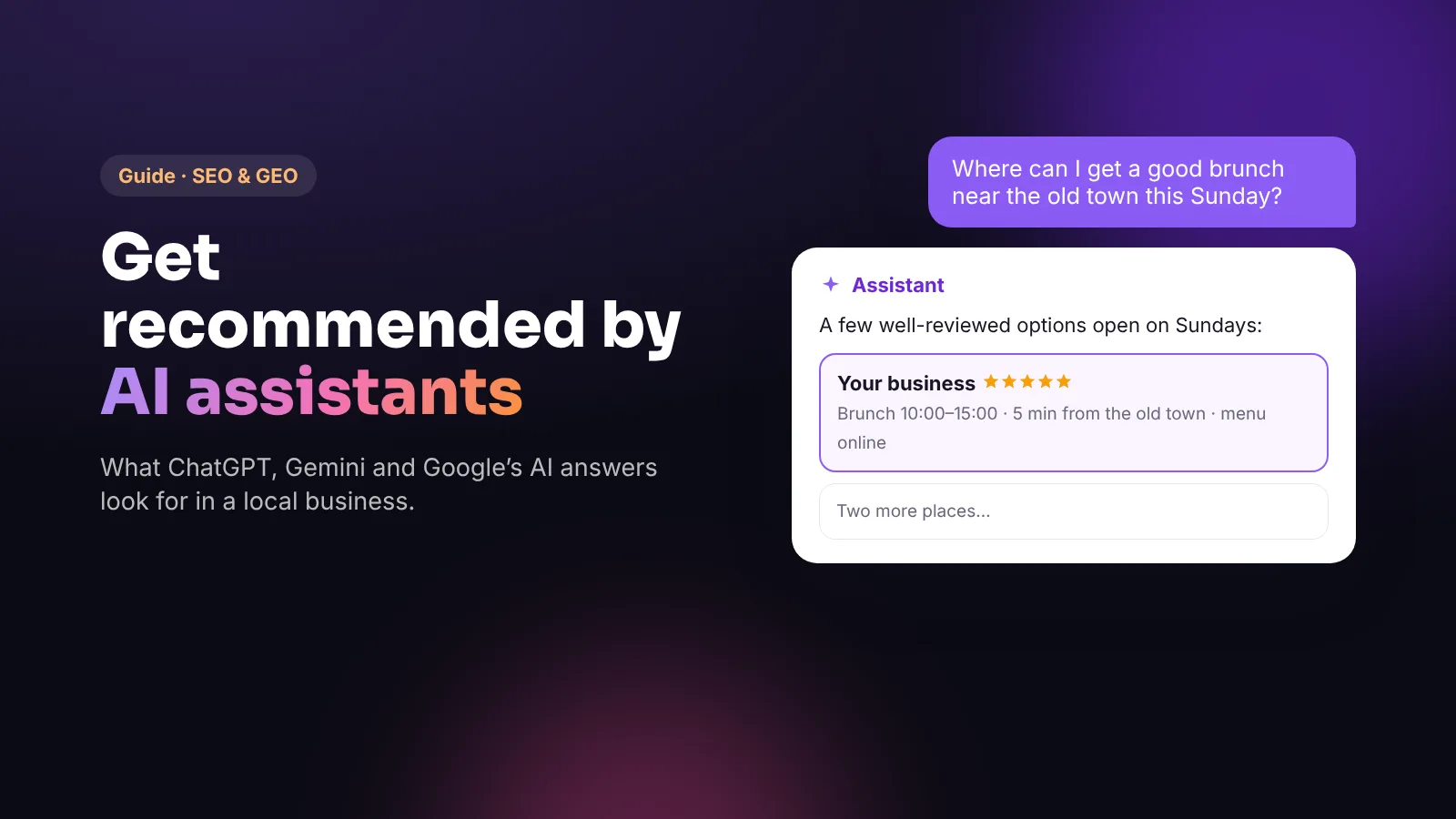
“Where can I get a good brunch near the old town this Sunday?” A growing number of people now ask questions like this to an AI assistant — ChatGPT, Gemini, Copilot or the AI answers at the top of Google — instead of scrolling through a list of links.
The assistant replies with a short list of places and a sentence or two about each. If your business is on that list, you’ve won a customer before they’ve even visited a website. If it isn’t, you may never know you were in the running.
This is what people mean by GEO — generative engine optimisation. It isn’t a mysterious new discipline. It builds on good local SEO, with a few extra habits that make your business easier for AI tools to understand and describe with confidence.
How AI assistants decide what to recommend
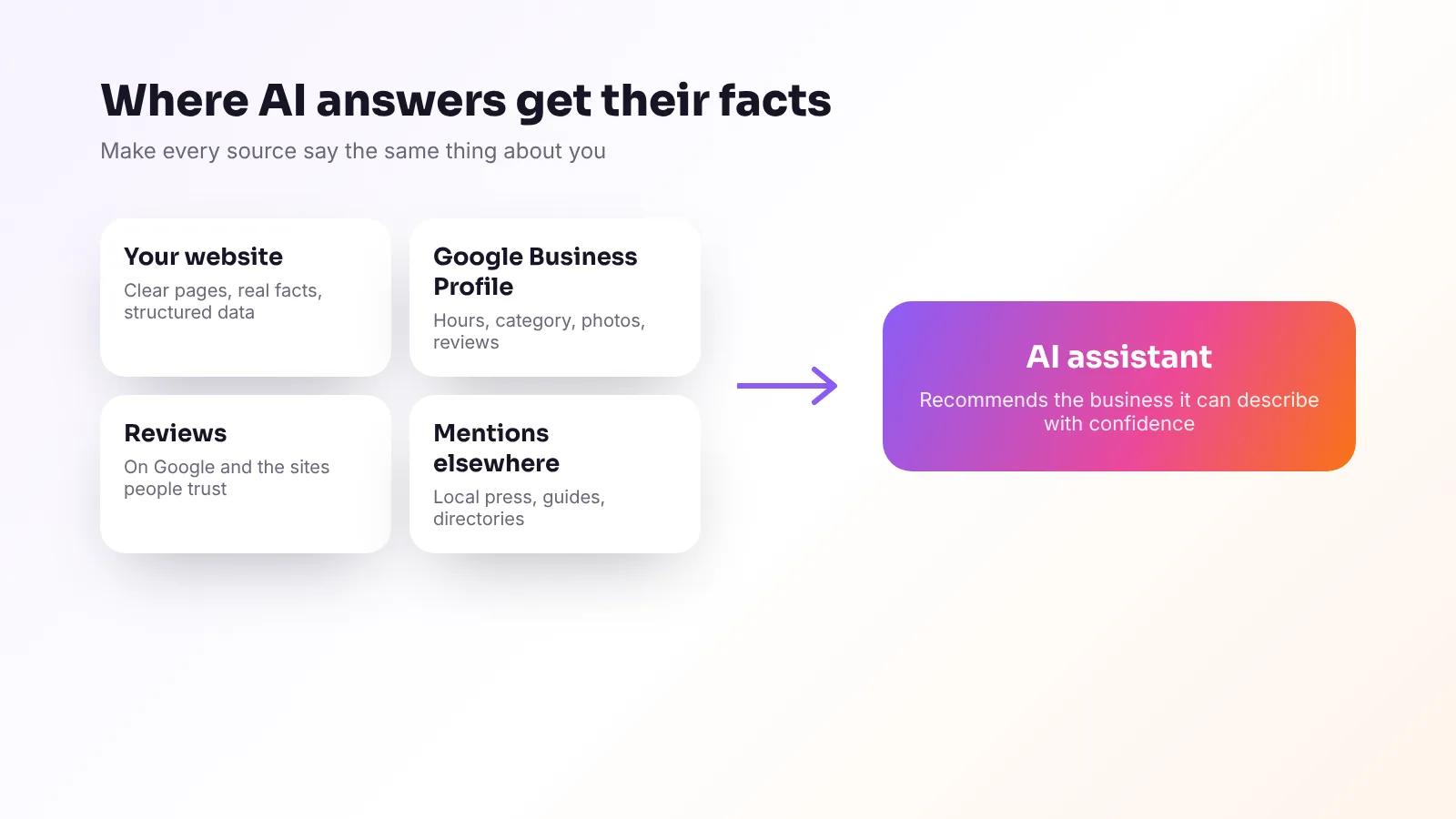
There’s no single formula, and each company works differently, but the broad picture is clear. When an assistant answers a question about local businesses, it draws on information it can find and trust: websites, maps and business listings, reviews, and mentions in articles, guides and directories.
Assistants tend to recommend businesses they can describe accurately and confidently. That means clear, consistent facts — what you are, where you are, when you’re open, what you’re known for — repeated across several trustworthy sources.
1. Get the basics right everywhere
AI tools cross-check information. If your website says you close at 22:00, Google says 23:00 and Facebook says you’re closed on Mondays, you look unreliable.
- Keep your name, address and phone number identical on your website, Google Business Profile, social media and directories.
- Keep opening hours and holiday hours up to date everywhere.
- Describe what you are the same way each time: “family-run tapas bar in the old town”, not five different descriptions.
Your Google Business Profile is the most important listing to get right — our complete checklist walks you through it.
2. Make your website easy to understand
Your website is the one source you fully control, so make it work hard.
- Write in plain language. Say clearly what you do, where, for whom and what makes you different. Avoid vague slogans.
- Answer real questions. Add a short FAQ: Do you take bookings? Is there parking? Are you dog-friendly? Do you have vegan options? These are exactly the questions people ask AI assistants.
- Put key facts in text, not only in images. Menus, prices and opening hours inside a photo or PDF are much harder for software to read.
- Use one clear page per service or location rather than cramming everything onto the home page.
- Keep it fast and mobile-friendly. If people struggle to use it, so may the tools that read it.
3. Add structured data
Structured data is a small piece of code that labels the facts on your website so machines can read them reliably: this is the business name, this is the address, these are the opening hours. The common vocabulary for it is schema.org, with specific types for restaurants, hair salons, shops and many other businesses.
If your website is built on a modern platform, there may be a setting or plugin for it. If not, it’s a quick job for whoever looks after your site — and it helps both search engines and AI tools.
4. Earn reviews and mentions
Assistants lean heavily on what other people say about you.
- Reviews: a steady flow of genuine reviews on Google and the platforms people trust in your sector. Our guide to getting more reviews the honest way explains how — and the rules to follow.
- Mentions: local news, “best of” lists, tourism sites, event listings, partner businesses and industry directories. Each trustworthy mention that describes you accurately adds to the picture.
- Social media: an active Instagram or Facebook profile with clear information in the bio reinforces that you’re open and what you do.
5. Let the right crawlers in
AI companies use automated crawlers to read websites. Your website’s robots.txt file can allow or block them, and it’s worth checking that you haven’t blocked them by accident.
- OpenAI explains its crawlers in its crawler documentation. OAI-SearchBot is used to show websites in ChatGPT’s search features, separately from GPTBot, which collects training data — so you can allow one and block the other.
- Google offers a separate Google-Extended setting that controls whether your content is used for its Gemini models. According to Google’s documentation, it doesn’t affect how your site appears in Google Search.
If you’re not sure what your robots.txt says, ask your website provider. For most local businesses, the goal is simply to make sure the tools that recommend businesses can read your site.
6. Write content that answers questions
Helpful articles on your website — like the ones in this Guides section — give AI tools more accurate information to draw on, and give customers reasons to trust you. Think about the questions you hear every week:
- “How long does a balayage take?”
- “What’s the best time to visit to avoid queues?”
- “Can you cater for coeliacs?”
A short, honest page answering each one is useful to customers and to the tools that help them choose.
7. Check how you appear
Every few months, ask a few AI assistants the questions your customers would ask: “best [your business type] in [your area]”, “where to [do what you offer] near [landmark]”. Note whether you appear, and whether the details are right. If something is wrong, fix it at the source — usually your website, your Google Business Profile or an outdated directory listing.
What not to do
- Don’t publish fake reviews or stuff your pages with keywords — it can backfire with search engines, AI tools and, in the UK and EU, the law.
- Don’t create lots of thin, near-identical pages for every nearby town.
- Don’t make claims you can’t back up (“the best in Spain”). Specific, verifiable facts are more convincing to people and to machines.
Frequently asked questions
What is GEO?
GEO, or generative engine optimisation, means making your business easy for AI assistants such as ChatGPT, Gemini and Google’s AI answers to understand, trust and recommend. It builds on local SEO.
How do I get my business mentioned by ChatGPT?
Make accurate information about your business easy to find and consistent: a clear website with FAQs and structured data, a complete Google Business Profile, genuine reviews, and mentions on trustworthy sites. Also make sure your robots.txt doesn’t block OpenAI’s search crawler.
Does blocking Google-Extended affect my Google ranking?
According to Google’s documentation, Google-Extended controls whether content is used for its Gemini models and does not affect inclusion or ranking in Google Search.
Is GEO different from SEO?
They overlap heavily. SEO helps you rank in search results; GEO helps AI tools describe and recommend you. Clear, consistent, well-structured information helps both.
The bottom line
Getting recommended by AI assistants comes down to being clear, consistent and well regarded: accurate details everywhere, a website that answers real questions, structured data, genuine reviews and trustworthy mentions. None of it is a trick — it’s good local marketing, done thoroughly.
Viraluna Studio’s SEO & GEO service takes care of all of this for you, from structured data to content that answers your customers’ questions. Ask for a free quote.